Industry News
Whether you’re building your own brand or expanding your product line, we offer reliable manufacturing, flexible customization, and professional support.
Content
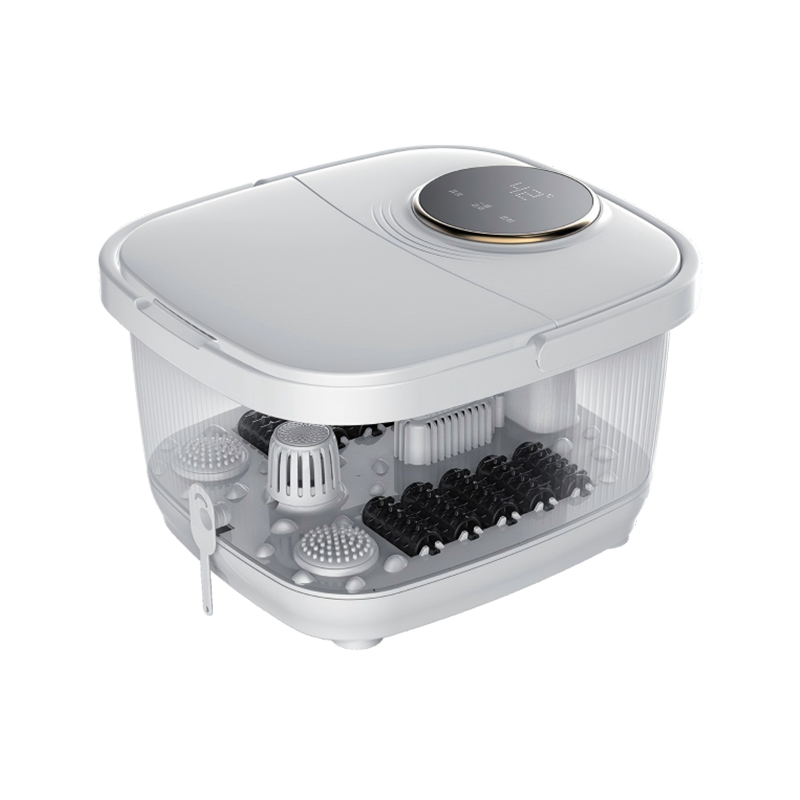
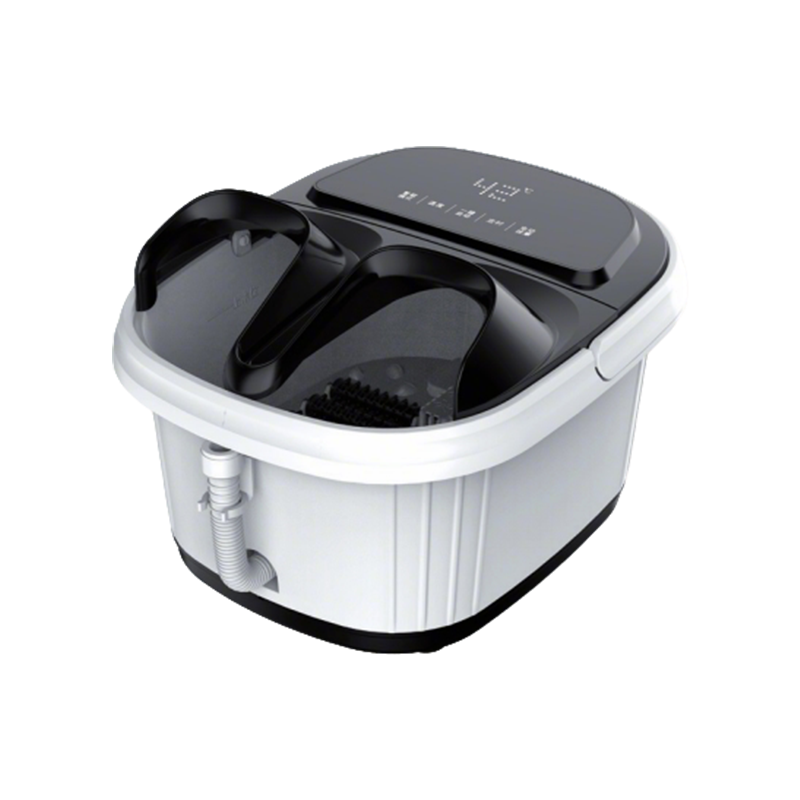
The short answer: when you source a Foot Spa Bath Massager for resale, control type, heating and pump design, and electrical safety documentation decide almost every downstream outcome, from return rates to how smoothly a shipment clears customs. Tub shape and color matter less than most buyers expect. A model with a modest feature list and stable water heating will usually generate fewer complaints than a feature-heavy model with an unproven control board.
This guide is written for buyers who deal with a manufacturer or supplier directly: importers, wholesalers, wellness retailers, hospitality purchasers and brands planning an OEM line. It walks through the four common control and structure types, shows how to compare suppliers on practical criteria, and then extends the same logic to Circulating Fan products, since many factories in this category, including ours, make both and many buyers want to consolidate shipments.
Throughout the article, the charts are illustrative planning models. They are built to help you structure a decision, not to report measured market statistics. Where a figure comes from a public standard, we say so. Where it is a judgment, we label it as one.
Most problems trace back to buying on the sample rather than on the production process. A single hand-built sample can look excellent. What you actually need to know is whether the factory can reproduce the same heater tolerance, the same motor noise level and the same fit of the tub seam across thousands of units. That is why the later sections spend more time on process questions than on feature lists.
A second common mistake is choosing a model for the wrong sales channel. A tabletop knob unit that works well in a pharmacy chain may not suit a salon that wants preset programs. The heatmap later in this article is designed to make that match explicit.
Key takeaway: judge a Foot Spa Bath Massager by its heating stability, pump durability and safety documentation first, and by its feature count last.
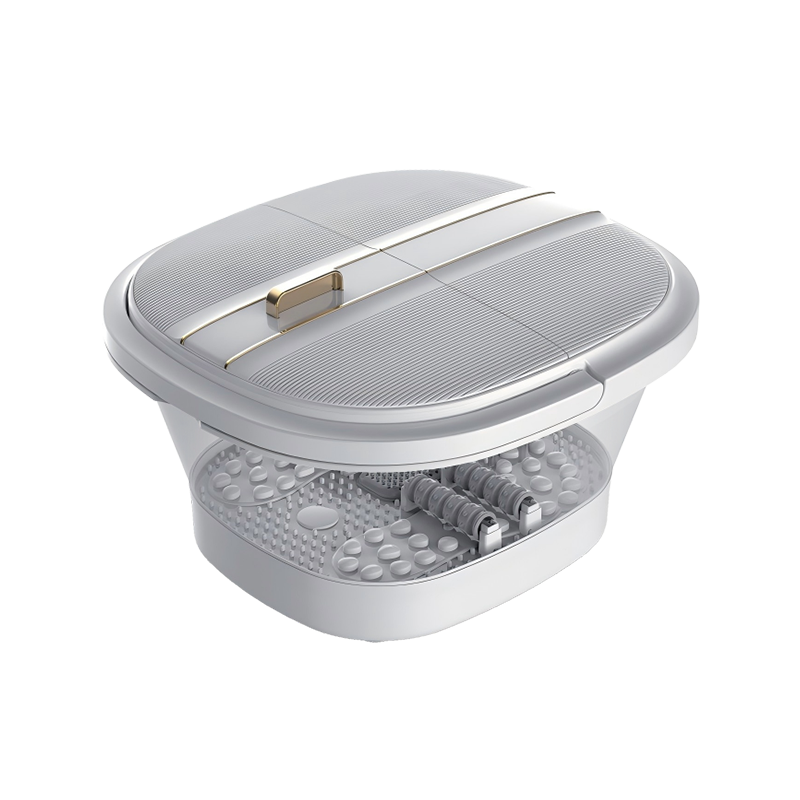
A Knob-Style Foot Spa Bath Massager uses mechanical or simple rotary switches to control heating, bubbles or vibration. The conclusion for most buyers is straightforward: this is the lowest-complexity option, and it is a sensible entry point for retail programs where users value predictability over programmability.
Because there is no microcontroller board, there are fewer components that can fail from moisture or voltage fluctuation. Service is also easier. If a switch fails, a replacement part is usually inexpensive to stock and simple to fit, which matters for distributors who handle after-sales themselves.
Without sensor feedback, temperature control is coarser. Buyers who position a product around precise heat settings or timed sessions will find the format restrictive. Knob-style units also leave less room for differentiation in a crowded listing, so the brand story, packaging and accessory set carry more weight.
When you evaluate a knob-style sample, test the knob itself. Rotate it a few hundred times by hand and check for looseness, and confirm that markings stay legible after repeated contact with wet hands. These are small checks that reveal how seriously a factory treats user-facing parts.
Key takeaway: knob-style models suit buyers who want dependable, easy-to-service units and plan to differentiate through packaging and accessories.
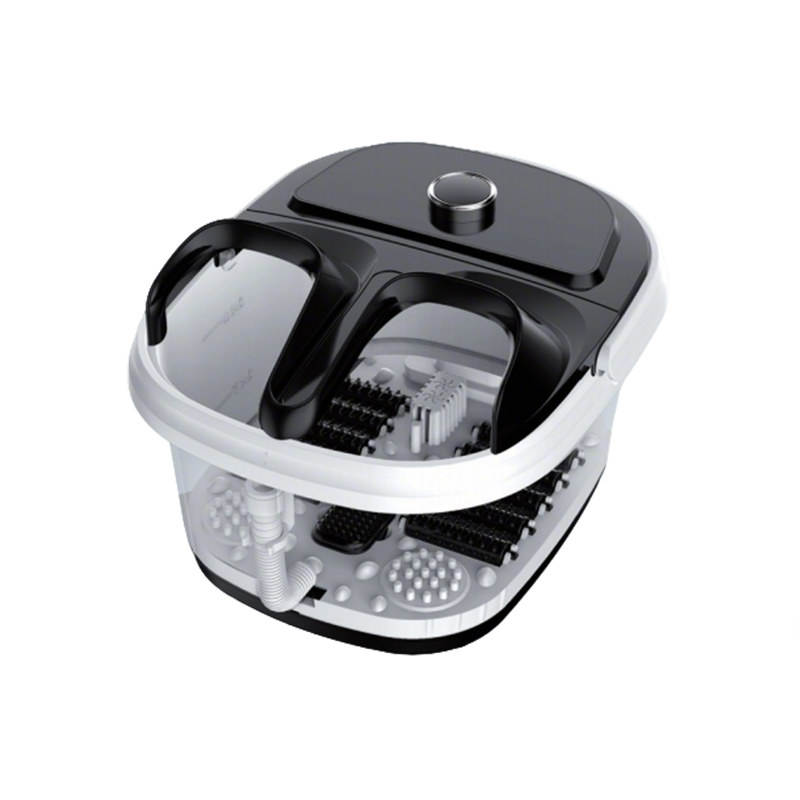
A Computer-Controlled Foot Spa Bath Massager adds a control board, usually with a touch or button panel and a display. The short conclusion: it earns its place in channels that sell on convenience features, such as preset programs, timers and temperature readouts, but only if the board is properly protected against moisture and the firmware behaves consistently.
Typical functions include adjustable heating targets, timed sessions, bubble and vibration modes, and in some designs a roller or acupressure sequence. For a salon or a wellness reseller, programmability lets staff run a consistent routine without manual adjustment. For a retail brand, it gives marketing something concrete to describe.
That last question is easy to overlook. If a factory changes a chip or firmware version between batches without notice, two shipments of the same model number can behave differently. Ask for a change-notification process in writing, and make it part of your purchase terms.
Key takeaway: a computer-controlled model is only as good as its moisture protection, independent thermal cutoff and firmware change control.
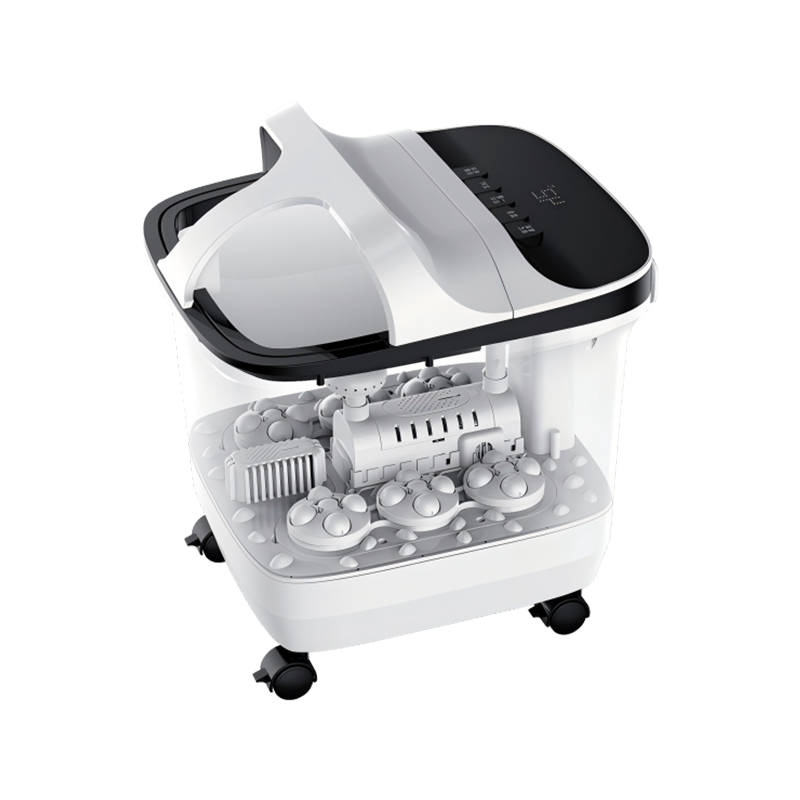
An Electric Foot Spa Bath Massager is the broad category that covers most heated, powered foot baths. Whether it is knob-controlled or computer-controlled, the same handful of components determine long-term performance, so inspection effort should concentrate there.
| Core components of an electric foot spa and what to check on a sample | ||
| Component | Role | What to check |
| Heating element | Warms and holds water temperature | Warm-up behavior, thermal cutoff, scale resistance |
| Motor and pump | Drives bubbles, vibration or circulation | Noise, vibration transfer, continuous run behavior |
| Tub body | Holds water and supports the user | Seam quality, stability when full, material odor |
| Power cord and plug | Supplies power safely | Plug type for your market, cord strain relief |
| Massage rollers or nodes | Provides tactile stimulation | Smooth rotation, edge finish, wear after repeated use |
On safety, the relevant reference point is the IEC 60335 family of standards for household appliances. IEC 60335-2-32 addresses massage appliances, and the general requirements in IEC 60335-1 apply to heated, water-contact products. Which exact standard and which national version apply depends on your destination market, so ask your supplier for the test reports their lab has issued and confirm with your own compliance contact. Typical market-access marks include CE for the European Union, UKCA for Great Britain and ETL or similar listings for North America.
Key takeaway: concentrate inspection on the heater, pump and plug, and request test reports that match your destination market.
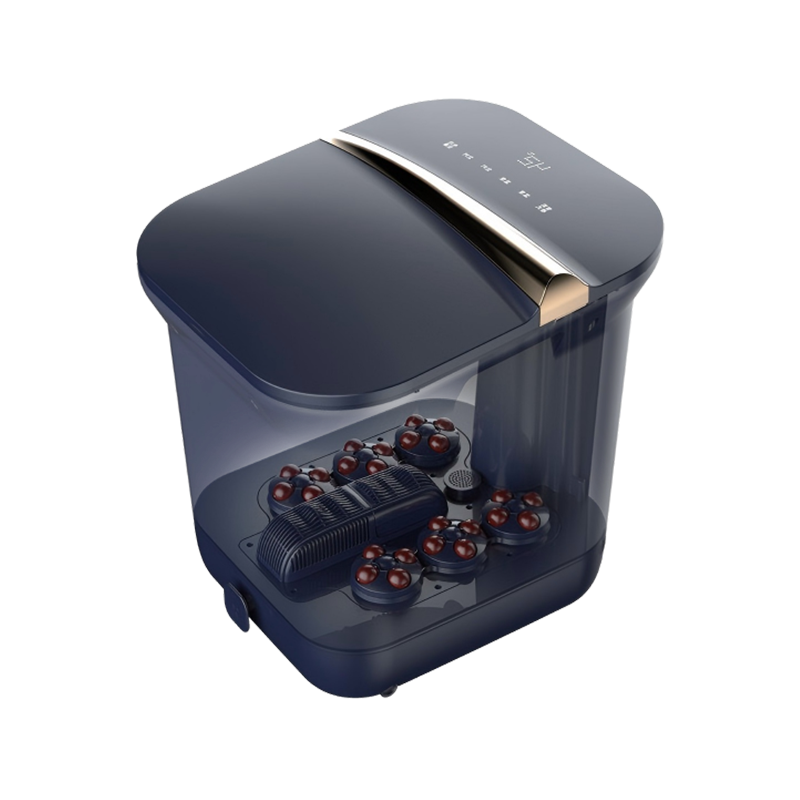
A Water Circulation Foot Spa Bath Massager moves heated water through jets or channels so that temperature stays more even and the user feels flowing water against the feet. The conclusion for buyers: circulation designs can feel more premium, but they ask more of the pump, seals and cleaning access, so the supplier's engineering depth matters more than with a simple bubble unit.
In a well-designed circulating unit, the pump pulls water from one zone and returns it through another, which reduces cold spots near the base. In a poorly designed one, flow can be weak, noisy or prone to leaking at the pump housing. Ask to see the pump seal construction and request a run test with water for an extended period, observed by your own inspector or through a video call.
Buyers serving salons and hospitality clients should check how easily the user can drain and wipe the unit. Tight channels that trap residue become a complaint source. Look for a drain design that empties fully, smooth interior surfaces and removable parts where practical.
Transit damage on tubs with pumps and moving parts often comes from inner packaging that lets the unit shift. Ask for a drop test result on the final retail carton, not on a prototype carton, and check whether the carton design keeps the cord and accessories from pressing against the tub wall.
Key takeaway: for circulation models, verify pump seals, drain design and packaging as carefully as the heating performance.
The most useful way to compare a manufacturer or supplier is a weighted scorecard that you agree on internally before reading any quotation. The chart below shows one example weighting for a Foot Spa Bath Massager program. Treat it as a starting template and adjust the weights to your own risk profile.
Before the chart, a note on how to read it. Each bar represents the share of your decision that a criterion should carry, out of a total of 100. A buyer with a history of transit damage might raise the packaging weight, while a buyer entering a new regulated market might raise the safety weight further.
The chart places safety and mechanical durability at the top, together accounting for 45 of 100 points. That reflects the fact that a failure in either area carries the highest cost in returns, claims and market-access problems. Control and heater reliability and tub construction share the next tier, because they shape daily user experience.
Packaging and documentation each carry 10 points, which may look low but is deliberate: these are areas where a capable manufacturer can usually meet requirements if asked clearly. OEM flexibility carries the smallest weight because it is a differentiator rather than a risk factor. A factory that can change the logo but cannot control heater tolerance is not a good partner.
For a company like Ningbo Guanyi, which develops and produces small home appliances in-house, the practical advantage in this framework is that engineering and production sit under one roof, so answers to technical questions come from the people who actually build the product. When you evaluate any supplier, ask who answers your engineering questions and how quickly.
Key takeaway: fix your scorecard weights before you open quotations, and give safety and mechanical durability the largest share.
No single model suits every channel. The heatmap below compares the four types discussed above against four common buyer scenarios. The scores are our planning judgments on a 1 to 5 scale, where a darker cell indicates a stronger fit based on typical channel needs. They are not survey data, and your own market knowledge should override them where it differs.
Read each row to see where a model type performs well, and each column to see which types are worth shortlisting for that channel.
The strongest cell for retail entry programs is the Knob-Style Foot Spa Bath Massager, mainly because of its simple use and lower service burden. Spa and salon use leans toward Water Circulation designs, where the sensory quality of flowing water is part of the service experience.
Hospitality supply sits in the middle for most types, since hotels and resorts typically care more about durability and ease of cleaning than about any single feature. Wellness distributors show strong fit for general electric models and computer-controlled units, which are easier to explain to end customers through feature descriptions.
The lighter cells matter as much as the dark ones. A computer-controlled unit placed into a pure price-driven retail entry program may carry more features than that shelf can use. If you are unsure, ask the manufacturer whether the same chassis is available with both control styles, which lets you test two channels without developing two separate tubs.
Key takeaway: choose the control style by sales channel, and ask whether one chassis can support both knob and computer control.
A Circulating Fan is designed to move air around a room so that temperature and freshness feel more even, rather than to push a strong stream at one person. The conclusion for buyers: this category pairs naturally with foot spas in a seasonal wellness and comfort range, and consolidating both in one purchase can reduce coordination work with separate suppliers.
Air circulator fans typically use a deeper blade and a tighter, more directed airflow than a standard oscillating fan, aiming to keep air moving across a whole room. Buyers should ask for airflow measurements taken under a stated test method, noise readings at defined speed settings and the oscillation range, rather than relying on general descriptions.
Both products are small, motor-driven household appliances with similar safety document needs. Both rely on stable motor quality, careful assembly of plastic housings and clear user instructions. A factory that controls those fundamentals for one category usually has relevant processes for the other. For importers, shipping both on a combined container plan can also simplify forwarding and documentation.
Key takeaway: pair foot spas with a Circulating Fan range to build a comfort-focused assortment from one manufacturing partner.
Desktop Air Circulator Fans suit offices, bedrooms and small treatment rooms, while Pedestal Air Circulator Fans suit living rooms, larger salons and waiting areas. The choice follows the space the buyer's customers actually have, not the feature list.
| Desktop and pedestal air circulator fans compared on buyer-relevant points | ||
| Point | Desktop Air Circulator Fans | Pedestal Air Circulator Fans |
| Typical space | Desk, bedside, small room | Living area, larger room |
| Stability concern | Base grip on smooth surfaces | Stand weight and tip resistance |
| Packaging | Compact, often fully assembled | Flat-pack with assembly steps |
| Main complaint source | Noise at higher speeds | Assembly difficulty, wobble |
| Shipping efficiency | Good carton density | Flat-pack improves density |
For pedestal models, the most common field complaint relates to assembly and wobble rather than airflow. Ask for the assembly instruction sheet early and have someone unfamiliar with the product build a sample, timing the process and noting where they hesitate. For desktop models, listen to noise at the highest speed in a quiet room, since that is where users tend to notice it.
The relevant safety standard family for household fans is IEC 60335-2-80. Confirm with your supplier which national variation and test reports apply to your destination market.
Key takeaway: pick desktop or pedestal by the customer's room size, and test assembly and stability, not only airflow.
Quality control for these two product families should focus effort where each is most likely to fail. A foot spa combines water, heat and electricity, so electrical safety carries the largest share of inspection attention. A fan is dominated by its motor and rotating parts, so mechanical checks take the lead.
The stacked bars below show an example split of inspection effort across four areas for each product. The split is a planning illustration, and your own quality agreement should reflect your product's history.
The foot spa bar puts 35 percent of the effort on electrical safety, which includes insulation checks, grounding continuity where applicable and heater cutoff verification. For the fan, mechanical and motor checks take 35 percent, covering blade balance, bearing noise and oscillation mechanism wear.
Appearance and packaging hold equal shares in both bars. They matter because a unit that works perfectly but arrives scuffed or with a missing accessory still produces a complaint. A clear inspection checklist for these items is cheap and effective.
A practical approach is to agree on an inspection standard, such as a defined sampling plan, before production starts, and to agree on how defects are classified. This gives both sides a shared language when a batch has issues, and it reduces disputes after the fact.
Key takeaway: weight inspection toward electrical safety for foot spas and toward motor and mechanical checks for fans, and agree on defect classes in advance.
A balanced line usually anchors on one hero category and supports it with two or three adjacent categories that share customers. The donut chart below shows an example order mix for a distributor who leads with foot spas and adds fans and other small appliances. The proportions are illustrative and meant to show the logic of a diversified first order.
Look at how the hero category holds the largest share without crowding out the others.
Foot spas take 40 percent in this example, which reflects a hero category approach. Fans take 25 percent, giving the assortment a warm-season and cool-season rhythm that smooths out seasonal demand swings.
Personal care and wellness items add 20 percent, which are natural cross-sells in the same store or catalog. Kitchen and environmental appliances make up the remaining 15 percent, such as air fryers or air purification products that a broad small-appliance manufacturer can supply in the same program.
The point is not the exact percentages. It is the principle that one capable manufacturer can supply several adjacent categories, which reduces the number of supplier relationships you must audit, schedule and communicate with.
Key takeaway: lead with one hero category and add adjacent small appliances from the same manufacturer to reduce supplier management work.
If you plan a private-label line, the most useful step is to decide what you want to change and what you want to keep. Changes such as color, logo, packaging and accessory sets are generally quick. Structural changes such as a new tub shape or a new control layout require tooling and testing, and they take longer.
The golden sample is a small step that prevents large disagreements. When a production unit differs from the approved sample, both parties can compare against the same physical reference rather than arguing from memory or photographs.
Also plan your communication rhythm. A short weekly update during production, with photos from the line, helps catch drift early. Most manufacturers are comfortable with this when it is requested at the start of the project.
Key takeaway: lock a golden sample and a defect classification before production, and keep a regular update rhythm during manufacturing.
From Cixi to the World: A Trusted Partner for Global Wellness Appliances. Ningbo Guanyi Electrical Technology Co.,Ltd. focuses on the research, development and manufacturing of small home appliances, and continues to refine product structure and performance based on real-world usage scenarios.
From foot spas to air fryers, and from environmental appliances to personal care and wellness products, the company serves global customers through stable manufacturing capability and ongoing technical expertise.
In 2017, the company entered a key development phase. Faced with evolving industry trends and shifting market demands, it adopted a quality-first strategy. By optimizing product structures and manufacturing workflows, it built its initial product portfolio and production base.
By 2025, the company had established systems for R&D, production and management, supported by a skilled talent pool and expanding production capacity. Consistent product quality and reliable service have helped it build a base of long-term partners and move into a period of sustained growth.
This marks the company's transition from individual product improvement to structured product line development. For buyers, that means a single manufacturer and supplier that can discuss Foot Spa Bath Massager programs, circulating fan ranges and related small appliances within one engineering and production framework.
Key takeaway: Ningbo Guanyi combines in-house development and production across foot spas, fans and other small appliances for global partners.
A Knob-Style Foot Spa Bath Massager is usually the simpler starting point because it has fewer electronic components and is easier to service. If your channel values presets and timers, a Computer-Controlled model may fit better. Ask the manufacturer whether both can share one tub design so you can test either option.
Request test reports that match your destination market, the product specification sheet, an instruction manual draft, and a description of the factory's inspection process. Compliance requirements differ by country, so confirm the exact list with your own compliance contact.
Desktop models are compact and often shipped assembled, so noise and base grip are the main checks. Pedestal models are usually flat-packed, so assembly clarity, stand stability and wobble deserve more attention during sample review.
Yes. Both are small motor-driven household appliances with similar quality and documentation needs. Ningbo Guanyi Electrical Technology Co.,Ltd. develops and produces small home appliances across several categories, which allows a combined program under one manufacturing partner.
Your email address will not be published. Required fields are marked *
LEARN MORE
LEARN MORE
LEARN MORE
LEARN MORE
LEARN MORE
LEARN MORE