Industry News
Whether you’re building your own brand or expanding your product line, we offer reliable manufacturing, flexible customization, and professional support.
Content
The short answer: when you source a Tower Heater, the control type, the safety cutoffs and the thermostat behavior matter more than the casing design or the number of modes on the label. A narrow tower fits into bedrooms, offices and hallways because it takes little floor space, but that compact body also concentrates heat, so internal layout and protection devices deserve closer attention than they do on a larger appliance.
This article is written for buyers who work directly with a manufacturer or supplier: wholesalers, importers, retail category managers and brand owners planning an OEM range. It covers the four tower heater formats buyers ask about most, which are the Mechanical Tower Heater, the Computer-Controlled Tower Heater, the Clothes-Drying Tower Heater and the Electric Fireplace Tower Heater. In the second half it turns to the Oil-Free Air Fryer, because many small appliance factories, including ours, build both and many buyers prefer to consolidate seasonal orders.
A note on the charts: they are planning models and illustrations, not measured market statistics. Where we mention a standard, it is a public reference you can verify. Where we offer a judgment, we label it as one.
A tower format stands upright, often oscillates, and warms a room by moving heated air outward rather than radiating from one face. For small rooms that is a practical advantage. For the buyer, the format also stacks well in a warehouse and ships in a tall, narrow carton that uses pallet height efficiently. Those logistics points are easy to overlook when comparing models on a spec sheet.
The flip side is stability. A tall, narrow body can tip more easily than a wide, low heater, so base design, weight distribution and tip-over protection are central checks. We return to them in the safety section below.
Key takeaway: judge a Tower Heater by its protection devices, thermostat behavior and base stability first, and by its mode count last.
A Mechanical Tower Heater uses rotary dials and a bimetal or capillary thermostat instead of a control board. The conclusion for most volume programs is that it offers a direct, easy-to-explain product with fewer parts that can fail, which suits channels where shoppers want to plug in, turn a dial and be done.
Without a circuit board, there is no firmware to revise and no display to translate. Service is simpler too: a worn dial or a switch can be replaced without diagnostic equipment. For a wholesaler who handles warranty claims, that lower service burden is a real operating advantage.
A mechanical thermostat switches at a wider temperature band than an electronic sensor, so room temperature drifts a little more around the set point. That is acceptable for many homes but may disappoint buyers who market precise comfort. When you inspect a sample, turn the dial through its full range many times and check for looseness, and run the unit in a closed room to see how the thermostat cycles in practice.
Key takeaway: a Mechanical Tower Heater suits volume channels that value simplicity and easy service, with the trade-off of a wider temperature swing.
A Computer-Controlled Tower Heater replaces the dial thermostat with a temperature sensor and a control board, usually paired with a remote or touch panel. The conclusion: it delivers tighter temperature holding and timer or schedule functions, which helps in channels that sell on comfort and convenience, as long as the board and sensor are well protected and the firmware is stable.
Common functions include a target temperature display, adjustable timer, multiple heat levels, an eco or maintain mode and a remote controller. Some designs add Wi-Fi or app control, though that adds software support responsibilities that many buyers prefer to avoid in a first program.
The second question matters most. A software controlled shutdown is helpful, but a protective device that does not depend on software is the layer you want behind it. Ask to see where it sits in the airflow path and what temperature it responds to.
Key takeaway: with a computer-controlled model, check sensor placement, an independent hardware cutoff and a written process for component changes.
A Clothes-Drying Tower Heater is a heater designed with a drying function in mind, typically through a warm airflow mode, a defined drying position or an accompanying rack. The conclusion every buyer should carry into the conversation: drying clothes on or near a heater is only appropriate when the product is designed and labeled for it, and ordinary tower heaters must never be covered or draped with laundry.
That distinction shapes both product design and the instruction manual. A genuine drying-oriented model should state the permitted method, the minimum distance between fabric and the air outlet, and the maximum load. If a supplier cannot answer those points clearly, treat it as a warning sign about how the product was developed.
| Review points for a drying-oriented tower heater | ||
| Review point | Why it matters | What to request |
| Air outlet design | Keeps fabric away from hot surfaces | Drawing or photo showing outlet position and guard |
| Overheat protection | Limits risk if airflow is partly blocked | Description of cutoff type and test method |
| Instruction manual | Tells users what is and is not allowed | Draft with clear warnings and distance guidance |
| Accessory rack | Defines how laundry is positioned | Load limit and stability check |
For room heater safety, the reference point is the IEC 60335 series, and IEC 60335-2-30 is the part that deals with room heaters. Your destination market may apply a national variation, so ask the supplier which test reports exist and confirm them with your own compliance contact.
Key takeaway: only a heater designed and labeled for drying should be sold for that use, and the manual must state distances, loads and warnings.
An Electric Fireplace Tower Heater combines a tower body with a decorative flame effect, usually created by LED lighting and a reflective or layered screen. The conclusion: the flame effect is a visual feature that runs independently of the heating element in most designs, so buyers should evaluate the heater and the display as two separate systems.
That independence is useful. A retailer can promote the ambiance function year-round and the heating function in cold months. It also means the flame module needs its own checks, including light uniformity, brightness settings, heat from the LED driver and the noise level of any small motor behind the screen.
| Tower heater formats compared on buyer-relevant points | |||
| Format | Control approach | Typical channel | Main inspection focus |
| Mechanical Tower Heater | Dials, mechanical thermostat | General retail, rental | Dial feel, thermostat cycling |
| Computer-Controlled Tower Heater | Sensor, board, remote | Comfort-focused retail, online | Sensor placement, firmware |
| Clothes-Drying Tower Heater | Mechanical or electronic | Humid-climate households | Outlet design, manual warnings |
| Electric Fireplace Tower Heater | Heater plus flame module | Home decor, gifting | Flame module, noise, finish |
Key takeaway: treat the flame module and the heater of an Electric Fireplace Tower Heater as two systems, each with its own checks.
Every Tower Heater supplier will list safety features, but the useful question is how each one is built and tested. The chart below ranks six checks by the attention we suggest giving them during sample review. The scores are an illustrative planning model on a 1 to 10 scale, meant to help you allocate inspection time rather than report test data.
Use it as a starting template and adjust the order if your market has specific rules.
Overheat protection sits at the top because it is the layer that acts when something else goes wrong, such as a blocked inlet or a failed fan. Tip-over protection follows closely, which is especially relevant for a tall, narrow body. On the sample, tilt the unit while it is running, in a controlled setting, and confirm that it switches off as the documentation says.
Cord and plug quality come next, since a heater draws significant current and a loose plug or thin cord is a recurring field problem. Thermostat accuracy and fan noise are comfort factors that shape reviews and returns. The flame module scores lower only because it applies to one format; for Electric Fireplace Tower Heater models it deserves a full check of its own.
A capable manufacturer should welcome these tests and be able to describe how each protection device is validated in production, not only in development. That difference between a design that passes once and a process that repeats is what protects an importer over a long program.
Key takeaway: put overheat and tip-over protection at the top of your sample review, and ask how each is validated in production.
The practical difference between a mechanical thermostat and an electronic one is how tightly the room temperature stays around the set point. The line chart below is a conceptual illustration of that behavior, not a laboratory measurement. It shows two heaters warming the same room toward the same target.
Pay attention to the swing after the first warm-up phase, not the speed of the initial rise.
Both lines reach the target area at a similar time, which reflects that heating power is set by the element, not by the control type. After that, the mechanical line swings visibly above and below the set point, while the electronic line stays closer to it. This is the core of the comfort argument for a Computer-Controlled Tower Heater.
It does not make the Mechanical Tower Heater a poor choice. For many rooms and many users, a wider swing is barely noticeable, and the simpler construction carries its own benefits. The chart simply helps you match the control type to the promise you plan to make on the box.
In practice, ask the manufacturer to run each candidate model in a closed test room and share a temperature log. A real log from your own sample is far more useful than any generic curve, including this one.
Key takeaway: electronic control narrows temperature swing, mechanical control simplifies the product, and a real test log from your sample settles the question.
The short answer: an Oil-Free Air Fryer is a compact countertop appliance that cooks with fast-circulating hot air, so food can be prepared with little or no added oil. For buyers, the decisive factors are airflow design, basket coating durability and temperature control accuracy, followed by the control interface, which defines the product tier.
Air fryers sell on convenience. Shoppers expect quick preheating, an easy-to-clean basket and a control panel they can understand without reading the manual. A supplier that builds heating and airflow properly will deliver consistent results from batch to batch, while a poor design shows up as uneven browning and customer complaints.
On safety documentation, household air fryers are commonly assessed under parts of the IEC 60335 series, such as IEC 60335-2-9 or IEC 60335-2-13, depending on how the appliance is constructed. The right reference for your market should be confirmed with the supplier's test laboratory and your own compliance contact. Also check food-contact material declarations for the basket and tray, since many markets require them.
Key takeaway: judge an Oil-Free Air Fryer by airflow, coating durability and protection devices first, and treat the control interface as the tier decision.
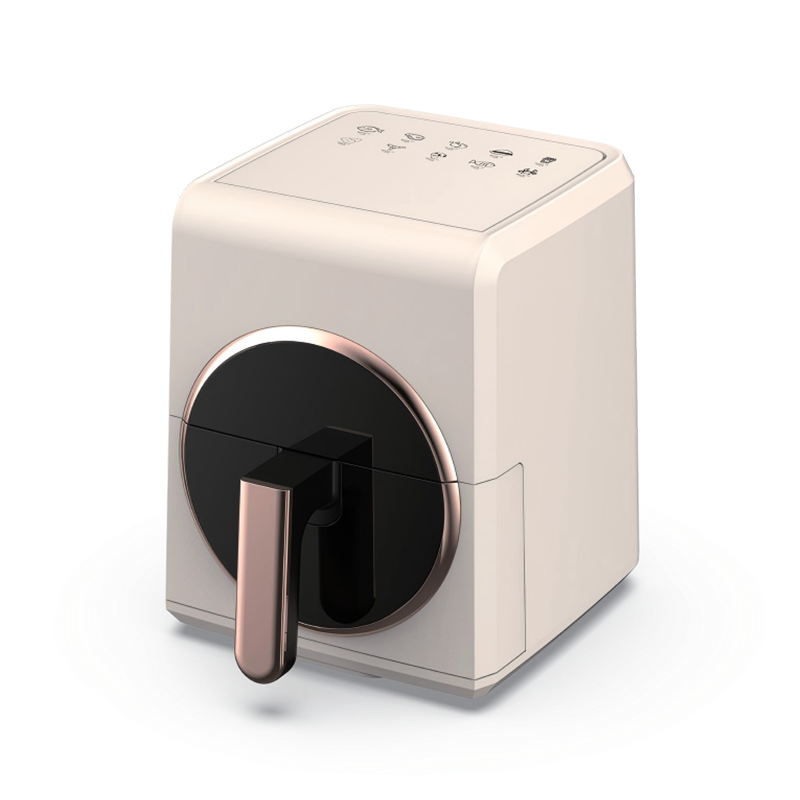
The control interface is the clearest way to separate air fryer tiers, and the right choice depends on the channel. A Single-Button Oil-Free Air Fryer is the simplest to use, a Dual-Knob Oil-Free Air Fryer gives direct manual control of time and temperature, and a Touchscreen Oil-Free Air Fryer adds presets and a richer display.
One button typically starts a fixed program or cycles through a few settings. It suits shoppers who want minimal choices and distributors who want a product that is easy to explain. Fewer parts also make the unit easier to service, though cooking flexibility is limited.
Two knobs, one for time and one for temperature, give users a direct and familiar way to control cooking. This format is popular in mainstream retail because it is intuitive and does not depend on a display. Check the knob detents and the timer bell behavior, since these are the details users notice daily.
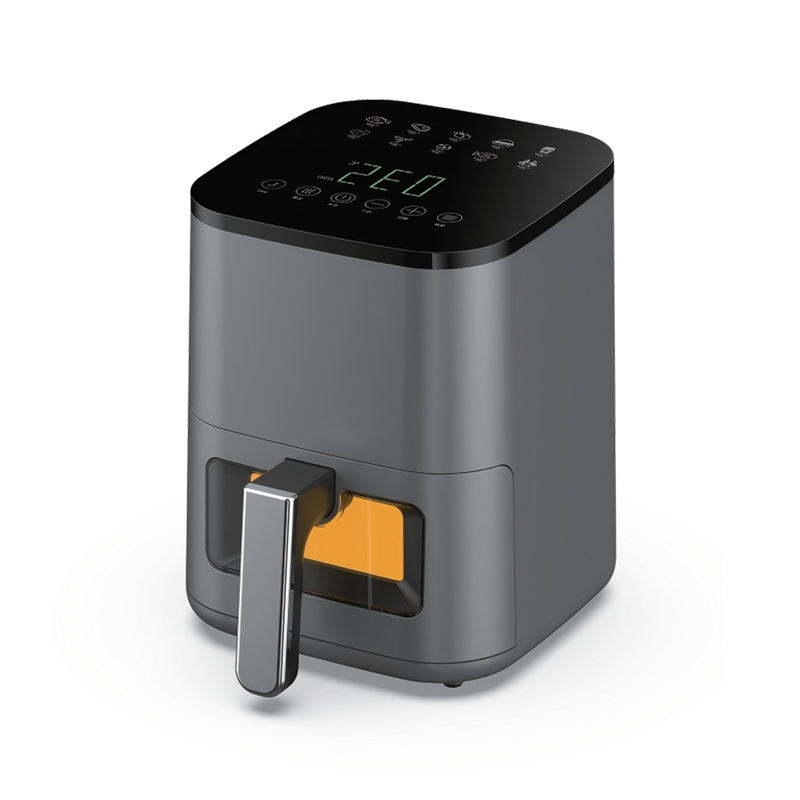
A touch panel allows preset programs, shake reminders and clear temperature readouts. It also gives the brand room to differentiate through interface design and language support. The trade-offs are a more complex control board, a need to protect the panel from steam and grease, and more firmware to manage.
The radar chart below compares the three formats on five dimensions. Scores are illustrative planning judgments on a 1 to 5 scale, intended to show relative strengths, not measured results.
The Single-Button shape reaches far toward ease of use and service simplicity but stays close to the center on presets and display flexibility. The Touchscreen shape is the opposite, extending to cooking control, presets and display flexibility while pulling in on service simplicity.
The Dual-Knob shape sits between them, with solid cooking control and moderate service simplicity. That balance explains why it is common in mainstream retail ranges. No shape covers the whole chart, which is the point: each control type is a trade-off, and the right pick depends on who will use the product and who will support it.
A manufacturer that can offer the same basket and chassis with all three control types lets you test different channels without developing separate bodies, which shortens development and simplifies spare parts planning.
Key takeaway: single-button favors simplicity, dual-knob balances control and service, touchscreen favors features, so choose by channel and ask for a shared chassis.
Before placing a first order with any new manufacturer, a short audit of documents, process control and test equipment tells you more than a sample alone. The progress rings below show an example readiness profile for a supplier under review. The numbers are illustrative and are meant to show how to summarize an audit, not to describe any specific factory.
Each ring represents the share of checklist items satisfied in one area.
In this example, testing equipment scores highest and process control lowest, which is a realistic pattern for a factory that invests in instruments but is still formalizing batch records. A buyer reading this profile would focus the follow-up questions on traceability rather than on the test lab.
For a Tower Heater, process control includes how protection devices are fitted and checked on the line. For an Oil-Free Air Fryer, it includes how the basket coating is applied and inspected. Asking to see those steps, in person or by video, is more informative than reading a summary.
A single audit does not remove the need for pre-shipment inspection, but it sets expectations and shows how the manufacturer responds to findings. Open, specific answers to difficult questions are a good sign, and vague answers deserve a follow-up.
Key takeaway: summarize a supplier audit in a few areas, and aim follow-up questions at the weakest one, usually traceability and process control.
The conclusion: heaters and air fryers complement each other in a small appliance assortment because their demand peaks fall in different parts of the year, and both rely on similar manufacturing foundations. A heater range sells into the cold season, while an air fryer range supports year-round kitchen demand with its own peaks around holidays and promotions.
From a manufacturing standpoint, both products depend on stable heating components, careful wiring, good plastic molding and disciplined final testing. A factory strong in one category usually has relevant processes for the other. For an importer, one supplier relationship can mean fewer audits, one communication channel and simpler container planning.
This sequence keeps early risk low and builds supplier trust before more complex items are added. It also gives you real sales data to inform later choices instead of relying on forecasts alone.
Key takeaway: phase a combined heater and air fryer program from simple to complex, using one manufacturer to reduce coordination work.
For private-label programs, decide early what you want to change. Color, logo, packaging, accessory sets and manual language are quick changes. Body shape, control layout and heating structure involve tooling and new testing, so they take longer and should be scheduled with test lab time in mind.
The golden sample prevents arguments about what was approved. If a production unit differs, both parties compare it with the same physical reference, which resolves most disputes quickly and fairly.
Key takeaway: separate quick OEM changes from structural ones, and lock a golden sample before production begins.
From Cixi to the World: A Trusted Partner for Global Wellness Appliances. Ningbo Guanyi Electrical Technology Co.,Ltd. specializes in the research, development and manufacturing of small home appliances, continuously refining product structure and performance based on real-world usage scenarios.
From foot spas to air fryers, and from environmental appliances to personal care and wellness products, the company delivers reliable solutions to global customers through stable manufacturing capability and ongoing technical expertise.
In 2017, the company entered a key development phase. Faced with evolving industry trends and shifting market demands, it adopted a quality-first strategy. By optimizing product structures and manufacturing workflows, it built its initial product portfolio and production base.
By 2025, the company had established robust systems for R&D, production and management, backed by a skilled talent pool and expanding production capacity. Consistent product quality and reliable service have helped it grow a solid base of long-term partners and step into sustained growth.
This marks the company's transition from individual product improvement to fully structured product line development. For buyers, that means a manufacturer and supplier able to discuss Tower Heater programs, Oil-Free Air Fryer ranges and related small appliances within one engineering and production framework.
Key takeaway: Ningbo Guanyi develops and produces small home appliances across several categories, allowing combined programs under one manufacturing partner.
A Mechanical Tower Heater is the simpler starting point with easier service and fewer electronic parts. A Computer-Controlled Tower Heater suits channels that value tighter temperature holding, timers and remote use. Many buyers test one of each to compare sell-through.
No. Only a Clothes-Drying Tower Heater designed and labeled for that purpose should be used with laundry, and only as the manual describes. Ordinary heaters must never be covered or draped with clothing.
A Dual-Knob Oil-Free Air Fryer is common in mainstream retail because time and temperature are controlled directly. A Single-Button model fits very simple offers, and a Touchscreen Oil-Free Air Fryer fits channels that value presets and a display.
Yes. Both rely on stable heating components and disciplined testing. Ningbo Guanyi Electrical Technology Co.,Ltd. develops and produces small home appliances in several categories, which supports combined programs from a single supplier.
Your email address will not be published. Required fields are marked *
LEARN MORE
LEARN MORE
LEARN MORE
LEARN MORE
LEARN MORE
LEARN MORE